How to play FLAMES: the paper love game, step by step
Romeo and Juliet come out of FLAMES as Enemies, which, given their families, is hard to argue with. FLAMES is the pen-and-paper love game kids have played in the back of exercise books for generations: two names, a bit of crossing out, a count around six letters, and a verdict.
What FLAMES stands for
Each letter is a possible relationship. The common version reads:
- F – Friends
- L – Love (or Lovers)
- A – Affection
- M – Marriage
- E – Enemies
- S – Siblings
Playgrounds have their own readings. A can be Admirers or Attraction, E sometimes means Engaged instead of Enemies, and S turns into Sweethearts in kinder versions. Agree on the meanings before you start, because arguing about E after the result is half the fun and all of the trouble.
How to play FLAMES, step by step
- Write both names one under the other, first names only, in the same form (no nickname against a full name).
- Cross out shared letters in pairs. For each letter that appears in both names, strike it once in each name. Romeo and Juliet share only E, so you strike one E in each.
- Count what is left. Romeo leaves R, O, M, O (4 letters) and Juliet leaves J, U, L, I, T (5). Total: 9.
- Write F L A M E S and count along it, starting at F, until you reach your number; wrap back to F when you run off the end. Strike the letter where the count lands.
- Keep going from the next letter. Start the next count on the letter right after the one you struck, using the same number, and skip struck letters.
- Stop when one letter is left. That letter is your answer.
Worked example: Romeo and Juliet
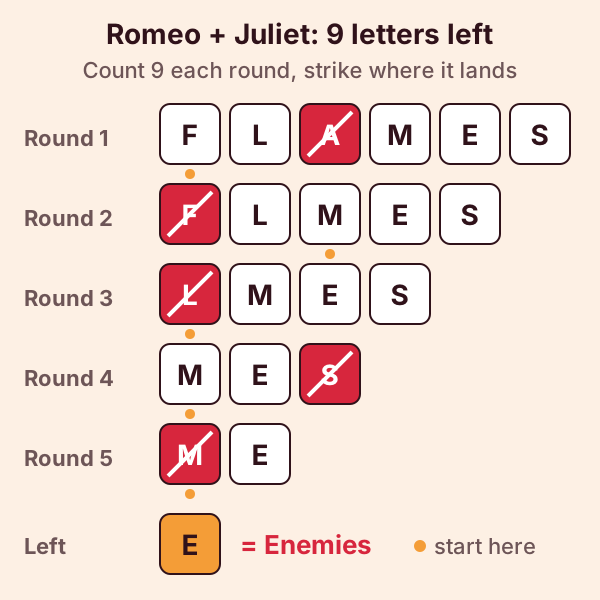
With 9 letters left, the first count goes F, L, A, M, E, S, F, L, A: strike A. The next count starts at M and runs M, E, S, F, L, M, E, S, F: strike F. Then from L: strike L. From M: M, E, S three times over lands on S. With only M and E left, the ninth step lands on M, and E is the last letter standing.
Shakespeare would approve. Try the same game with house rules, though, and the star-crossed pair can end up married, which is coming up below.
Two more pairs to practise on. Jack and Rose share no letters at all, so all 8 stay: F, L, A, M, E, S, F, L lands on L first, and after four more rounds A is left, Affection. Elizabeth and Darcy share only an A; Elizabeth keeps 8 letters and Darcy 4, so you count to 12, and the answer is Affection again. My advice when you play it with a group: write the six letters large, strike them with a single clean line so you can still read them, and say each count out loud. Nearly every disputed FLAMES result I have watched came from someone skipping a struck letter or forgetting where the last count ended.
Quick lookup: where each count lands
Because the rules are fixed, the answer depends only on the number of letters left. Here is the full lookup for 1 to 20, using the standard "carry on from the next letter" rule, so you can skip the counting:
| Letters left | Result | Letters left | Result |
|---|---|---|---|
| 1 | Siblings | 11 | Marriage |
| 2 | Enemies | 12 | Affection |
| 3 | Friends | 13 | Affection |
| 4 | Enemies | 14 | Friends |
| 5 | Friends | 15 | Marriage |
| 6 | Marriage | 16 | Friends |
| 7 | Enemies | 17 | Affection |
| 8 | Affection | 18 | Friends |
| 9 | Enemies | 19 | Love |
| 10 | Love | 20 | Enemies |
Look at the odds: across 1 to 20, Friends and Enemies come up five times each, Affection four, Marriage three, and Love only twice, at 10 and 19. If FLAMES ever tells you Love, frame it.
House rules that change the answer
I have seen at least three versions of this game played at the same table. They give different answers, so pick one and stick to it.
- Strike pairs or strike everything. The rule above strikes shared letters one-for-one. Some players strike every copy of a shared letter in both names. For Romeo and Juliet it makes no difference; for names full of repeated letters, such as Anna and Hannah, it changes the count a lot.
- Restart at F each round. Some players begin every count at F instead of the letter after the strike. Romeo and Juliet then end on M: Marriage. Same names, happier ending.
- Nothing left. Two identical names leave zero letters, and no version has a rule for that. Most players add surnames and try again.
- Full names. Adding surnames is allowed, but both people need the same treatment, or the result means even less than usual.
FLAMES or a love percentage?
FLAMES gives you a category; the LOVES test behind our love calculator gives you a number from 10 to 100. Both are pure letter games: no randomness, the same names always give the same answer, and neither knows anything about the people behind the names. FLAMES has only six outcomes and a strong lean towards Friends and Enemies; the percentage spreads pairs across ten bands and shows every row of the working with Show the math. Play FLAMES on paper with friends, then check the same pair in the calculator and see whether the two games agree. Romeo and Juliet: Enemies on paper, 88% Kindred Spirits online.
Frequently asked
What does FLAMES stand for?
Friends, Love, Affection, Marriage, Enemies, Siblings. Some versions use Admirers for A, Engaged for E or Sweethearts for S.
Do you count from F every time in FLAMES?
In the common version, each new count starts on the letter after the one you just struck. Restarting at F is a popular house rule, and it can change the result.
What if there are no letters left after crossing out?
That happens with identical names, and no version has an official rule for it. Most players add surnames and play again.